Aug 25-Jul 26

Thursday December 4th, 2025. Penllech-Porth Ysgaden. Jane led 14 ramblers on a walk between Penllech and Porth Ysgaden on the north coast of Penllŷn. It was an increasingly sunny and dry day, though chilly in a brisk westerly breeze.

The party set out from the spacious carpark near Traeth Penllech and made their way down the quarter mile path to the bay where the restricted and eroded access to the beach has now been improved. The route followed the Wales Coast Path north, initially on the sands, covered in windblown foam, and then on the muddy and often slippery path hugging the grassy and often eroded cliff top. The going was difficult on the first section especially on the ups and downs traversing stream gullies.

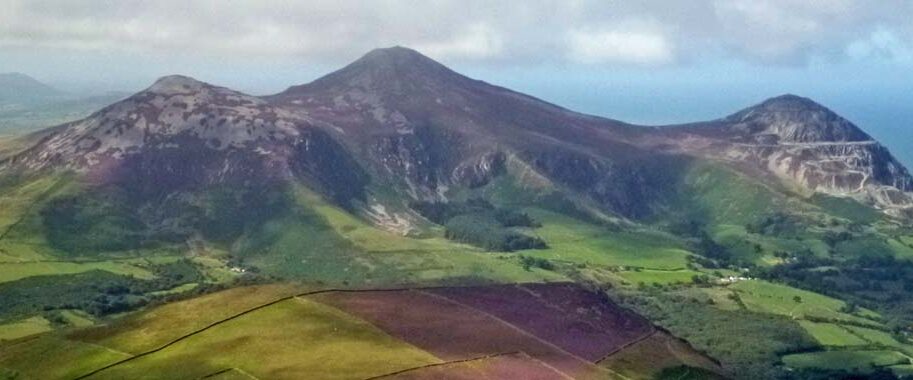
The coastal scenery was magnificent; the pounding waves perpetually drenched the dark crags and rocks in curling white spray. Steps led down to the small sheltered cove of Porth Ychain in time for a panad. The way up required crossing of a stream swollen by recent rain debouching across the beach at low tide. From here the clifftop path was easier and wider, opening up distant views of the peaks of Yr Eifl further up the coast and the striking grey screes of Garn Fadryn. Ahead, the surviving gable wall and chimney of a ruined cottage stood out conspicuously on the headland at Porth Ysgaden.

A customs officer lived here in the 18C, a reminder that this tiny inlet was once a thriving gateway for the local villages, where small boats brought in basic needs traded for local produce including salted herring (hence the placename). An old limekiln on the cliff edge processed imported limestone into fertiliser for local farms. The sheltered cove and the more exposed headland made grand sites for lunch.

Two more ramblers joined the group for lunch and the easier afternoon leg along the peaceful country lane half a mile inland running south back to the Penllech. A mile long detour was made to take a look at the delightful church of St Mary, rebuilt about 1840, its plain and simple interior now well cared for by Friends of Friendless Churches. It lies adjacent to a much altered 17C Plas once occupied by a branch of the Wynne family of Cefnamwch. The Church and Plas together formed a small manorial settlement unusual in Wales.

From there it was a short step back to the carpark after an enjoyable 7 mile circuit over some 4 hours. Noel Davey.

Sunday November 30th, 2025. Waun Oer. This Sunday’s walk was in the Dyfi Hills, over the fine Waun Oer ridge which rises on the eastern side of the Talyllyn Pass, opposite the end of the Cadair ridge. A party of 6 led by Adrian Thomas met at the large layby near the top of the pass where enthusiasts often gather to watch fighter jets perform their dramatic ‘Mach Loop’ flights low through the valley. It was quiet on this bright day with occasional showers.

The walk climbed a nearby steep path directly up to the ridge at 1800ft, gaining a thousand feet in less than an hour. A short coffee break was taken near the forest boundary on Mynydd Ceiswyn. From there the ridge led gently up to the trig point on Waun Oer, at about 2200ft the highest point of the day. Unfortunately, this coincided with a squally shower which wrapped the top in mist and temporarily blocked the views.

Further on, however, a splendid panorama opened up towards the flat top of Maesglase and along the swooping U-shaped valley of the Afon Cerist leading down Bwlch Oerddrws to Dinas Mawddwy; to the south, the hills of mid-Wales rolled out magically to the horizon.

Coming down from Waun Oer, there was a sudden and unexpected sharp drop of about 350ft into a narrow stream valley where a short steep section of slippery, rocky path proved challenging. Back up the grassy slope the other side, the ridge path led on to the Cloddfa Gwanas, a 19th century slate quarry. This was a wonderful viewpoint and an excellent spot for lunch in the weak winter sun, much to the consternation of sheep grazing perilously on the edge of an impressively deep pit. The elevation and remoteness of the quarry meant that the sporadic output had to be taken down by a packhorse track. This provided the walkers a rough and boggy, but easy moorland route down past Gwanas Fawr to the Afon Clywedog at 250ft near Pont Gwanas on the A470.

A short section on the main road led onto a metalled cycle track on the western side of the road, then climbing gently across fields past Gwerngraig and by a ford across a stream in full spate into open access moorland to contour back to the start point.

This proved an excellent and quite strenuous day out, covering about 9 miles and 2500ft of ascent in just over 5 hours. This left time for a final pitstop to recover in the always popular Cross Foxes at the A470 junction before the journey back to Llŷn in the dark. Noel Davey

Thursday November 20th Hafan y Mor - Chwilog - Afon Wen. A cold sunny day with the first snows of winter adorning the mountains of Eryri brought a group of 20 led by Kath  Mair to Hafan y Mor for a circuit on familiar paths and lanes between Chwilog and the coast. This replaced the programmed walk in the hills above Garn Dolbenmaen to avoid  adverse conditions expected on the moorland paths.

The route started along the old road near Capel Bachau, crossing the A497 at Afon Wen and taking a farm track and paths north to the B road leading into  Chwilog. The walk led through this large village, passing a number of recently built housing schemes, before turning off south-west on a country lane past the village school. A difficult stile at Penarth Bach took a short-cut across muddy fields to Penarth Fawr. The majestic trees and grass lawn in front of this fine medieval hall provided a pleasant sunny site for a morning panad.

A country lane continued south past the eastern boundary of the Broom Hall  Estate back to the main A497. After half a mile east along the  quiet narrow track of the old road surviving alongside between encroaching hedges, the route turned south down  the road to Penychain Station.   Once the arrival point for the city throngs at the old Butlins Holiday Camp, this provided a peaceful and comfortable spot for lunch untroubled by any passing Cambrian Coast trains.

The afternoon leg passed the substantial house at Penychain, skirting the greens of the Hafan y Mor 9-hole golf course  and reaching the wild headland of Penychain where the route joined the Wales Coast Path coming from Morfa Abererch. The path north from here hugged the shore, passing Porth Fechan, giving splendid views of the snowy peaks across the bay. There were interesting glimpses of the  impressive developments of the Holiday Park including the upmarket lodges and major coastal protection works. Eventually the path turned inland under the railway bridge leading back to Afon Wen.

The outing provided an enjoyable social walk of some 7.5 miles over 4.25 hours on easy terrain.   Noel Davey.

Sunday November 16th, 2025. Llanaber-Talybont. Today’s walk was the third stage of the Llwybr Cadfan, the recently opened Southern Pilgrim Route from Tywyn to Ynys Enlli. The Club walked the first two stages last winter. A bright, dry day with good visibility brought out 18 walkers led by Louise to Pwllheli and stations north to travel down the Cambrian Coast railway, always an attraction especially when concessions allow free travel for many of the group.

The walk started at Llanaber (leaving out the rather humdrum couple of miles along the promenade and coast road from Barmouth). The route led straight up from the station climbing steeply past St Mary and St Bodfan’s church by a narrow walled path awash with recent rain. Open walled fields offered the first of the day’s splendid vistas westwards across Cardigan Bay to the misty grey silhouette of the hills of Llŷn.

At an elevation of around 750ft, the path turned onto a grassy track towards the north, entering wilder open access moorland. This passed workings of the Hafotty manganese mine, the largest of the Merionnydd producers from 1835 to the end of the 19th century when they were supplanted by better quality continental ore. The route continued north climbing steadily to about 1250ft near Bwlch y Rhiwgyr. A feature now was the succession of ladder stiles marching across the geometric walls bounding huge upland fields. The lee of a wall provided a magnificent view for lunch and some useful shelter in now colder conditions.

A broad grassy track then turned north-west, allowing a fast pace gently down past the remains of neolithic stone circles, testament to the long history of settlement of this ancient landscape. At the historic bridge of Pont Fadog (featuring a 1762 date), the route turned west along the wooded valley of the Afon Ysgethin, leading along the northern river bank through delightful beech woods to the village of Talybont. A house named Llety Lloegr, marked by sentinel pines, once offered travellers an overnight bed, a reminder that this was the western end of the medieval packhorse and drover’s route across the mountains to the English livestock markets.

Most of the party made a short detour here to take a look at the Gors y Gedol megalithic tomb, noted for its striking tumbled capstone. The Ysgethin Inn on the entrance to Talybont was a welcome sight for a well earned pint or panad in good time before the party were due at the station to catch the 4pm train back to the Llŷn.

This was a great day of walking through a remarkable ancient landscape, covering 7.5 miles and over 2000ft of ascent in under 5 hours. Noel Davey

Thursday November 6th, 2025. Mynytho-Abersoch. Annie and Jean led 18 on a circuit from Mynytho to Abersoch and back. It was a bright, mild day, 14-15C and even warmer in early afternoon sunshine.

The walk started near the school below the rounded dome of Foel Gron, leading gently down past Wellington on the long scenic path to Abersoch. This follows the deep U-shaped valley of the Nant Fawr, though it is now only occupied by a small brook. It is also known as the ‘Old Reservoir’ path referring to the belt of narrow lakes which once provided Abersoch’s water supply, but are now a privately owned amenity area well maintained by the Bryn Cethin Bach holiday lodge site on the hill above. It is a good spot for water birds with a graceful flock of white swans and a few black ones in evidence.

The path eventually passed a sympathetically restored old mill house, coming out to the north of Abersoch harbour near Tide’s Reach Cottage beside a house called ‘Castell’. The latter may recall the historic site of a motte on the mound above, now better known as the site of the long beleaguered ‘White House Hotel’, where hope still lingers that a usable modern replacement will emerge one day from the half built purple-clad shell of the seemingly abandoned structure that stands there now.

The route climbed past some of the swankier holiday homes, soon turning inland above Fach Farm, a densely occupied static caravan site, long denuded of the trees that once screened this eyesore at the entrance to Abersoch. A late stop for coffee provided a good view of the Warren beach, Tir Cwmwd and the northern hills of Llŷn.

A muddy field of kale took the party close to an angular wind turbine, passing above the fine 17C gentry house at Castellmarch. Beyond Muriau the route turned into a charming hidden landscape of small hills, dells, woods and fields around Oeddwr. An enterprising couple have recently bought the house, outbuildings and some acres of land here to open the area up for use and access including the restoration of some abandoned rights of way.

At Penrhiwiau a path skirted the boggy heath below Mynytho, passing an ancient enclosure at Gadlys and detouring below Horeb Chapel to visit the important holy well of Ffynnon Fyw, now well maintained by AONB volunteers.

The final leg of the walk in Mynytho followed the perplexing network of lanes and paths in this strangely dispersed ‘village’, climbing back to the hill at Foel Gron.

This was a pleasant outing of some 5.4mls with much of interest and some good views. The worst of the mud was avoided and threatened showers held off. Noel Davey.

Sunday November 2nd 2025. Harlech - 3 Peaks. A group of 19 ramblers met below the castle walls at Harlech for a walk over ‘three peaks’ in Ardudwy led by Rita. It was a fine sunny day with a brisk breeze and good visibility.

The route climbed steeply up a wooded path, zigzagging to the north-east, steadily gaining superb views down to the castle and town and across the broad  Glaslyn estuary  towards Portmeirion and the Llŷn.   At around 1000ft the track levelled  out onto the  fields of the Ardudwy Plateau, passing the remote outposts of Rhyd Galed Uchaf and Merthyr Farm. The dense and intricate network of beautifully maintained walls are perhaps the most  astonishing feature of this unique upland landscape.

A brief ascent took the party to the top of Foel Senigl to enjoy  a morning panad and the fine vista  on the first of the day’s peaks. The prehistoric trackway of Fonllech Hir then marched north-east across the open plateau lined by some 8 ancient standing stones. This forms the gateway to the remarkable Moel Goedog, a fine prominence of some 1230ft, noted for its ring cairns crowned by a large Bronze Age hillfort. The peak provided a somewhat sheltered spot for lunch, offering a wonderful panorama of the peaks of southern Eryri.

The route now joined a section of the Ardudwy Way, a long-distance trail north to south across the plateau. Rough grassy paths made a loop eastwards to Moel Y Gerddi, the third peak of the day. This focussed on the dramatic spectacle of the rugged masses of the Rhinogydd mountains, their grey  strata etched sharply in the bright afternoon sunshine, rearing from the lake of Cwm Bychan in the valley below.

The Fonllech Hir then took the party back towards the south-west, soon  bringing the ancient streets of Harlech and the glinting waters of Bae Ceredigion back into view. The final section was a precipitous descent of the (controversially dubbed) ‘steepest street in the world’ back to the carpark below the castle walls.

This was a memorable walk of some 10  miles and 2600ft of ascent over 6.5hours, where the fine autumnal weather showed off the delights of Ardudwy at their best. Noel Davey.

Thursday October 23rd  2025. Bala-Moel Emoel. A party of 13 travelled  inland to Bala for a walk led by Nia in an attractive patch of countryside seldom visited by the Club. Storm Benjamin over from France augured poor weather; sun was certainly at a premium, but the rain and wind were  lighter than forecast. The walk was almost entirely on roads, tracks and paths within the Rhiwlas Estate which has  been owned by the Price family for over 400 years. Many of the elegant estate buildings remain, though the original Hall was demolished in the 1950s and replaced by a smaller house designed by Clough Williams Ellis. The start  point  was  by  now closed   Canolfan Cywain Centre/Gorwelion just  to the north of Bala.

The route climbed gently north through a well ordered estate landscape, framed by stands of golden beech and dark conifers, laced with bright strips of autumn larch. There was a pause for coffee  in a glade beside  an old but still intact white cottage. Eventually a wilder moorland track branched off to climb past the small lake of Llyn Maen Bras, an estate reservoir,  to the summit of Moel Emoel at 1830ft, one of a number of peaks around Foel Fach dotting an upland grassy plateau  close to the eastern boundary of Eryri National Park.

While it was quite damp and cold up here, there were some lovely muted views of  the hills all around stretching down to Bala and Llyn Tegid and up the Dee Valley towards Corwen. This wild upland landscape is imminently threatened by a proposal  to erect 11 giant wind turbines of 220m height, one of many windfarms which could soon transform much of the mid-Wales landscape.

The route turned back down south through Coed Foel Emoel where  a sheltered spot was found for lunch. This eventually led down to the estate  village of Llanfor, a harmonious  group of buildings clustered around Sant Mor’s  church. It was rebuilt in the Victorian era. A family mausoleum in the graveyard commemorates RL Price and his horse Bendigo, a source of spectacular race winnings.

The last leg took a field path known as Lover’s Walk winding  between  stately beeches across the estate park.  This was an interesting and enjoyable, if rather wet, outing covering  over 7 miles and 1500ft  of ascent, unusually strenuous for a Thursday walk.  Noel  Davey.

Saturday 18th October 2025. Yr Aran. It was a Saturday, and day earlier than planned, as the forecast for Sunday promised wind, cold and rain. It was correctly judged that Saturday would be a much better day although it meant that some members were unable to join the walk. The weather was overcast, pleasant with very little wind at the beginning.

The walk started off from the layby next to the entrance of Sygyn Copper Mine on the A498 from Beddgelert. A short walk on the footpath took us round the side of  Craflwyn Hall. The hall built in the 1890’s is a National Trust property. Then up and round to follow a little used and uneven path NE alongside Afon y Cwm. There were several pools in the river which would have been an attraction to some in warmer weather.

Further up we joined the main Craflwyn to Watkin Path, path and enjoyed a well maintained farm road. It didn’t last long. We turned north west onto a path which took us into Cwm y Hyrddod alongside Afon Hyrddod. About a third of the way up the Cwm a sheep fold provided a pleasant spot for the morning panad. From where, looking SE we could see over Llŷn Dinas to Yr Arddu and Cnicht.

With the wind picking up and the temperature dropping we made our way up to the bwlch (saddle) between Craig Wen and Yr Aran and arrived there just after 12 noon. There was no standing around thanks to the chilling effect of the wind. It was onward and upward to the summit with a 30 minute walk in very cold and windy conditions.

There was a group photograph on the summit and then it was down to the bwlch for lunch. The return path followed the ridge SSW to Craig Wen. Then it was generally an easy grassy descent giving us lovely views over Rhyd-Ddu, the end of the Nantlle Ridge, and Nant-y-Betws.

At about 960ft we turned east and eventually reached the A498 close to the entrance of the Cae Ddu Campsite Site. A very pleasant and totally level walk had us had us following the minor road to our starting point at the entrance to Sygyn Copper Mine.

A very challenging but enjoyable walk on a route to Yr Aran which the club had not done in the last 20 years, covering 6.5miles in just over 6 hours. Hugh Evans.

Thursday October 9th 2025. Talysarn Circuit. Colin Higgs led 25 members on a circuit from Talysarn on a gloomy but dry and mild day. The walk explored some of the slate quarries of the Nantlle Valley to the east and south of the village.

The walk headed first to the great Dorothea Quarry which closed in 1970, leaving three large flooded pits, now dramatic lakes popular for leisure use, and the remains of impressive engine houses  and winding towers. A tall brick structure with a clock still houses a remarkable Cornish beam engine installed in 1906 to pump water from the quarry pits. These are all now part of the Slate Landscape of the Northwest Wales World Heritage Site.

After a pause for a panad, the walk took a path to the south-west, climbing gently through the scruffy, abandoned slate landscape. A loop was made through the extensive workings  and past the wall of a deep quarried pit around Taleithin Isaf.

Lunch followed  on the elevated trackbed of a former quarry railway. From here there were good views towards the large villages of  Penygroes and Talysarn, the huge slate tip below Cilgwyn occupied by a former landfill site, and the mist shrouded summit of Mynydd Mawr.

The group were then privileged to visit the workshop and charming  garden of the artist Josie Russell, now well known for her delightful textile art celebrating the local landscape.

The route continued through the neat hamlet of Tanyrallt where there was an interesting chapel converted to flats. Field paths north-west brought the party across the Afon Llyfni to the old road back to Talysarn. Part of the group took an alternative, prettier but muddy path back alongside the river.

This pleasant outing on easy paths covered about 5 miles  over 4 hours. Noel Davey.

October 3rd-6th 2025. Elan Valley Club Walks Holiday. At the beginning of  October a group of 25 Club  members enjoyed 4 days of walking in the Elan Valley, an area of Wales few of them knew. They took over the Elan Valley Lodge, a rather splendid converted Victorian school built originally as part of the model village when the great engineering project to supply Birmingham with water was being constructed in the Valley. The privately run venue was well suited  to the needs of a walking group, providing a thoughtful package of individual bedrooms, useful communal spaces,  wholesome meals, an honesty bar, drying room  and guided walks.

The visit coincided with Storm Amy, the first named storm of the autumn, presenting very wet and windy weather on the first two days, but improving by the Sunday and Monday. In spite of this, 7 walks were completed, providing a mix of 3 ‘A’ grade   walks, each  of around 10 miles length, and 4 ‘C’ grade walks of 5-7 miles length.  Most of the walks were led by Steve, the Lodge Manager, and Tudor, a local shepherd. Both provided congenial company and a mine of information about  the Elan Valley reservoirs,  as well  as  other local history and characteristics of farming and rural life. Club members led two of the walks with advice from the Lodge.

The party met at Cwmdeuddwr in Rhayader Gwy in time for a picnic lunch under dripping  park trees, while a few found cover in the church porch. Noel then led an easy 4.75 mile walk over 2.5 hours  in persistent rain, taking in sections  of the Wye Valley Way, part of a long-distance  trail from Pumlumon to Chepstow. The route took a mix of field and woodland paths and the track of a section of the Mid-Wales railway closed in 1962. An unexpected and somewhat alarming feature of the route was a long and swaying Nepalese-style  rope bridge which saved the walkers having to try and ford the Wye in full flood.

The guided walks on Saturday and Sunday focussed on exploring the original four of the five main Elan Valley reservoirs  and their  associated dams and structures: Garreg Ddu, Pen y Garreg, Craig Goch and Caban Coch. The well marked trails and paths twisted around and  above the narrow  bodies of water in deep steep-sided valleys clad in wonderful deciduous woodland. An abiding memory will be trudging through the unusually deep carpet of beech mast and acorns which characterised  this fruitful autumn. The trees provided valuable shelter from the worst of the rain and wind. However, on Saturday, a venture onto the northern dam of Graig  Goch exposed some of the walkers to the full force of 60 mph gusts.   But when at last the sun came out and the gales calmed the autumn colours came into their own.

The energy, skills and imagination behind this extraordinary feat of Victorian engineering remains  awe inspiring, whether the solidity of the great stone dams, the elegant iconic towers which house the regulating machinery,  or the incredible gravity fed pipeline dropping just 171 feet over 73  miles down to Birmingham. The main phase of the project was completed in just 12  years.

The last two days brought better weather and a chance to visit some of moorlands and hills that lie above the valleys. This took the walkers to the unfinished Dolymynach  dam and the small Nant y Gro dam where Barnes Wallis famously tested the wartime ‘Dambusters’ bouncing bombs. On Monday, while Steve took the C walkers up through the Cnwch woods behind   the Lodge, Gareth led 6 on an expedition to climb Drygarn Fawr and Gorllwyn, both peaks over 2000ft high,  in the wilder hills and moorlands of the Elenydd  south of the Claerwen reservoir. This  was a strenuous walk of over 10 miles in 6-7 hours, providing amazing views over the mid-Wales landscape from the iconic beehive cairns  at the summit.

Then it was time for the 2-3 hour drive back to Penllŷn after a successful few days. The arrangements were something of an experiment but seemed to prove popular, particularly because the whole group were able to be accommodated together in one place.      Noel  Davey

Thursday September 25th  Porth Ysgo – Penarfynydd. Another day of warm and sunny late September weather was ideal for a visit to the coast at Porth Ysgo, one of the many gems of Penllŷn. Judith led 16 on a ramble from Ysgo Farm where there is  a field for parking at reasonable charge.

The path was taken directly down to the clifftop high above the Ysgo cove. There were spectacular  views of the steep rocky cliffs lining the sparkling waters of the bight curving from Trwyn y Penrhyn and Carreg Gybi in the west past  the striking tidal rock of Maen Gwenonwy to Porth Llawenan and the tip of  Mynydd Penarfynydd to the east.  

It was high tide, so the walk continued east along the clifftop past the remains of the manganese mining operations  which began here in the early 19th century, and boomed for 30 years from the 1880s, and again in wartime, when the metal became strategically important for toughening steel, finally closing in 1945.

A principal objective of the walk was to follow a new section of the Wales Coast Path, recently  opened, after many years of negotiation and delay,. This is a welcome new link, running along the clifftop and then north to Penarfynydd Farm. The new waymarking did not prevent the party losing their way onto quite difficult ground for a while, giving a break for coffee while the correct route was located.  

The route then climbed up to the trig point at 580ft on the northern section of Mynydd Penarfynydd, continuing across the heather moorland  gently down  the spine of the promontory to the headland at Trwyn Talfarach. The clump of rocks here  provided a wonderful spot for lunch with a backdrop of the mountainous coastline stretching around Bae Ceredigion to the far south, the mass of  Mynydd Rhiw to the north and the dramatic rocky headlands, cliffs and islands of the southern Llŷn coast.

A lower level path was taken back to Penarfynydd Farm and then field tracks and a lane to Llawenan.  Here the group divided: seven returned by the road via the interesting Church of Llanfaelrhys; nine followed the Nant Gadwen path, an  old mine tramway route, and took the 150 odd steps down to visit Porth Ysgo to bask for a while on the beach in the warm afternoon sunshine before the final haul back up to Ysgo Farm.

It proved a  pleasurable 4 hours, covering about 5 miles with a fair amount of climbing and  some tricky paths.   

Sunday September 21st  Around Yr Arddu. After two days of awful weather, 16 ramblers led by Hugh enjoyed a gorgeous Sunday in the hills around Yr Arddu just to the north-west of Croesor.The walk started in the Eryri carpark, leading through the village and up the steep lane towards Cnicht. Today’s route  soon diverged, climbing northwards on often quite boggy moorland to about 1200ft  where there was a stop for a panad near a small lake.

The path skirted the remarkable plateau-like ridge of Yr Arddu rising to almost 2000ft. This outcrop of bare fractured brown rocks  was the product of volcanic activity in the ‘Caradoc’ era about  450mn years ago. Its geological importance was attested by an encounter with a large group of university students from Keele, coming to study this striking formation. A long descent followed by a slippery, rocky path via Bwlch Battel down to Gelli Iago and the wooded  valley of Blaen Nanmor. There were superb crystal clear views across to the mountains around Yr Wyddfa.

The Nantmor Mountain Centre here has been providing basic accommodation for outdoor pursuits for over 60  years. The grassy enclosure in front of the simple house provided an idyllic spot for lunch.  The area is part  of the 500ha farm owned by the National Trust which encompasses the summit of Cnicht and Nant Gwynant. The afternoon route crossed the Nanmor and followed the bubbling river  south-west on paths under  a delightful dappled canopy of oak and hazel woodland.  At the edge of Dolfriog Woods, a more northerly  route was adopted. This passed Ty Mawr, a small hall-house of gentry quality and Tudor origin, for a time used as a hay barn, but now magnificently restored to its former glory.

A section on narrow country lanes brought the walk close to  Nantmor  village less  than 100ft above sea level. So from here, the only way was up via  Bwlch Llechog  and then east via Garreg Bengam across an often very wet open moorland track, reaching 700ft, before rejoining the outward route back down to Croesor.  A most enjoyable and relatively strenuous circuit covered 8 miles and over 1800 of ascent in some 6 hours. The day  was rounded off by well-deserved refreshments in late afternoon sunshine at Caffi Croesor.     Noel Davey

Thursday September 11th 2025. Aber Ogwen. A group of 19 members met at the beach carpark north of Aber Ogwen for a circuit led by Kath. It was a sunny day and the forecast showers and strong winds were avoided.

The walk set off west along the pebbly beach, skirting the Spinnies North Wales Wildlife Trust Nature Reserve, a series of wooded lagoons close to the Ogwen Estuary providing a valuable habitat for birds. This led on to a lovely two mile section of the Wales Coast Path around Penrhyn Castle. The route was opened last year after many years of planning and negotiation, while teething problems on a very muddy section have now been resolved.

The route hugs the shore, giving fine views across the Lafan Sands to Ynys Môn, Puffin Island and the Great Orme. Inland there were glimpses of the brooding towers of the castle built in Norman style in 1840 by the Pennant Family with profits from the Slate Quarry in Bethesda  and sugar plantations in Jamaica. However, there is no access from the path into  the stately woodland and broad fields of the surrounding parkland.

Coming out at Porth Penrhyn, there was a stop for coffee amid some of the old port buildings. Then the route turned south along the wooded Lôn Las Ogwen. This superlative asset for walkers and cyclists was the track of the former Penrhyn railway which brought slate from the quarry to the port. Two substantial but decaying railway bridges on the route  have recently been rebuilt at the same scale with funds linked to the Slate World Heritage Site.

After a mile or so, the walk turned east  onto a country road, stopping for lunch making use  around some large boulders  on the fringes of the still vacant Bryn Cegin business park. The rest of the walk continued on pleasant minor roads, crossing the A5 at Llandygai and the railway at Talybont.

The final leg followed the road back to the at Aber Ogwen. This  was  an easy and enjoyable outing of some 6-7 miles over 3-4 hours in an interesting and attractive landscape  on the outskirts of Bangor. Noel Davey.

Sunday September 7th 2025. Llanystumdwy Circuit. Kath Mair guided a group of 15 ramblers on a long ‘figure of eight’ route from Llanystumdwy. The weather was showery with sunny periods and a warm southeasterly wind.

The walk started at the village carpark, crossing the old Afon Dwyfor bridge near the grave of  Lloyd George and turning by the school up the lane past the Rabbit Farm. At the junction with the Rhoslan Road, a path continued north across the broad green fields of  Gwynfryn Farm, turning through woodland and on a recently  much improved section down to a country lane across the Afon Dwyfach. This led past  Betws Fawr,  the 18C birthplace of the locally celebrated poet, Robert ap Gwilym Ddu. Further on, the route turned south west near  Plashen Farm onto the wonderful Lôn Goed, a long, straight and broad  tree-lined track built from the coast in the 18C to ease carting of lime to enrich the acidic soils of inland estate farms.  Although somewhat battered by recent storms, this provided a delightful sheltered route and a good place for a morning panad.

The track was followed for a couple of miles as far as Afon Wen. Here the route joined the Wales Coast Path, cutting down to the shore near Sŵn y Don.  The path was followed south skirting the vast, but well screened holiday park of  Hafan y Môr where substantial works are underway to stabilise the coast and expand amenities. This  led past the cove of Porth Fechan onto the wild headland of  Penychain, where the strong onshore wind created a dramatic seascape of churning waves. The route now turned north through the Hafan’s  golf links, passing the listed  house of Penychain Farm, built by the Glynllifon Estate in the mid 19C.

Lunch followed at Penychain railway station where the  spacious  covered  waiting hall provided shelter from the damp. The afternoon leg continued on a fine hedged bridle way, skirting  the solar farm at Bryn Bachau and eventually reaching the long straight B road through Chwilog. At Wernol the route  cut south-east through a caravan park,  around an overgrown fishing lake and across  a rotting footbridge. This brought the party back again across the Lôn Goed and the Afon Dwyfach, passing the elegant gentry house of Ysgubor Hen, dating from 1700.

Near the end of the walk driving rain and spray from speeding traffic made a section along  the A497 unpleasant, so it was a relief to take the quieter back road finally back into Llanystumdwy village. This was a pleasant, sociable and quite fast-paced walk of almost  13 miles over 6 hours  through the  familiar and gentle  countryside of Eifionydd. Noel Davey.

Sunday 17 August 2025. Around Moel Goedog. This was an alternative to the much more difficult A walk in the Northern Carneddau area, 10 members assembled south of Harlech, led by Dafydd Williams, some 4 miles east of Llanfair/Llandanwg at the entrance to Merthyr Farm. It was another beautiful summers day with the temperature in the mid to high seventies with a cooling breeze.

The initial half mile was eastwards along the tarmacked road to a junction where a track went right and almost immediately forked where it was left along a defined track. A further half mile ahead eight of the walkers elected to climb Moel Goedog, 1200 feet, on the summit of which is the remains of a fort, rejoining the other two who had continued along the foot of the hill from where there were outstanding views of nearby Port Meirion and further up the Cardigan Bay coast, Criccieth Castle and the Lleyn Peninsula.

Still going east in another three quarters of a mile there was another diversion by means of a track on the right to a nearby small lake “Llyn y Fedw”. This time six elected to go and after a short delay re-joined the other four a good half mile further, on the hillside .

Soon the path reached the track of the Ardudwy Way coming north and lunch was taken on nearby convenient rocks. There were no diversions in the afternoon, the well marked sea facing route on a clear path was followed affording close views of Rhinog Fawr, Clip, Ysgafarnogod and Foel Senigl.

The outward road was eventually regained with only another half a mile back to the starting point. An extremely pleasant five and a half mile stroll over three and a half hours, the pace allowing plenty of time for conversing. Dafydd Williams.

Sunday August 17th, 2025. North Carneddau. Nine ramblers led by Gareth had a gorgeous day in the North Carneddau, having made a linear traverse of most of the other Carneddau peaks last year. The weather was sunny and clear, the heat tempered by a brisk breeze. The group met in Abergwyngregyn, finding the last few spaces in the village carpark as huge numbers descended to visit the iconic falls, their popularity ever inflated by social media.

One car shuttled some of the walkers, some hiked, 1.6 miles up the lane to a tiny parking space at the formal start point below Foel Dduarth.  An easy track was followed south east up the deep and narrow valley of Afon Anafon, passing a number of hut circles, an elaborate sheepfold and an inscribed stone, testament to the area’s historic significance. A community hydro scheme has an offtake from the river here which feeds a turbine in Aber. Higher up, Llyn Anafon was harnessed to supply water to Llanfairfechan in 1931, but  was decommissioned in 2022 , the remains of a stone weir now offering a welcome spot for a morning panad.

Now came a steeper path winding up to the south west through heather  to Foel Fras, at 3097ft the highest point of the day, and one of the 7 Welsh ‘3000s’ to be found in the Carneddau. The flat and stony summit provided a spectacular panorama  in all directions, stretching from the serried peaks of Eryri to the south and west, with just a peek of Yr Eifl in distant Llŷn; closer to hand to the north lay  the Arfon coast,  the Llafan sands across the  Menai to Ynys Môn and Puffin Island; to the east, the Great Orme looming over the town of Llandudno and a regimented backdrop of  wind turbines marching offshore.

The ridge track was retraced to reach the nearby  peak of Drum, some 600ft lower. The large  cairn at the summit  provided another good viewpoint  and venue for lunch, barely troubled by darting bees.

The afternoon route took heather paths in a north-westerly direction, gradually  descending along a ridge formed by  a chain of minor peaks reaching around 1600ft, comprising   Pen Bryn Du, Yr Orsedd, Foel Ganol and Foel Dduarth. The outward route of the silver Anafon snaked far below to the south  backed by the grassy ramps of Llwytmor, while the trackways and pylons of Bwlch y Ddeufain crossed to the north.

A short descent led back to the morning’s start-point and a shuttle back to the crowds in Aber after a  memorable day in the glorious  open spaces of the Carneddau plateau, covering some 10 miles over 8 hours  with over 4000ft of ascent.  Noel Davey

Thursday August 14th,2025. Talsarnau. Today’s walk was a circuit in the attractive  wooded  hills of Ardudwy above Talsarnau just down the coast from Penrhyndeudraeth. 18 ramblers led by Colin met at the station carpark behind the Ship Aground pub. A warm and humid day of initial cloud and a sprinkling of rain soon gave way to sunshine.  

The walk led south, crossing the A496 to climb steps and a steady pull up through delightful oak woodlands of Coed Cae’r Ffynnon. This area is part of the historic estate of Glyn Cywarch built by William Wynn in the 1616 and the Harlech family seat since the 1800s. 

There was an early stop for coffee at a viewpoint at about 350ft. The route then turned north down to the pretty village of Soar, passing the  impressive Soar Methodist Chapel. A climb over  a scarp shrouded by the Black Wood brought the party into the verdant valley of Afon y Glyn where a country lane led north through  Coed Garth Byr.  A path climbed gradually through the woods of Ceunant Coch, reaching Llyn Tecwyn Isaf, a charming lake known for its dragonflies and fishing, and a perfect spot for lunch in the sunshine.  

The afternoon route circled south through the hamlet of Bryn Bwbach, taking the country lane back down to Talsarnau.  There were spectacular views across the Dwyryd Estuary to Portmeirion, Llŷn and the Moelwynion.

This proved a pleasant outing of some 5-6 miles with  an ascent of 850ft  over 4 hours. Noel Davey

Sunday August 10th, 2025  Llan Ffestiniog Valleys and Falls. The magic tract of wooded river valleys and waterfalls around Llan Ffestiniog, though not widely known, has become a regular attraction for the Club. A group of 13 ramblers led by Eryl made a (rescheduled) circuit here on a dry, bright and warm day, taking in the rivers Cynfal, Teigl, Goedol and Bowydd, all tributaries of the Dwyryd.

The first segment was a descent south to view the spectacular Rhaeadr Cynfal plunging through the dramatic gorge of Ceunant Cynfal, part of a National Nature Reserve. Climbing back through the eastern quarters of the town, the route headed north along the lovely banks of the Afon Teigl, passing Caer Blaidd and offering a pleasant site for a coffee break.

After passing the tall chimneys of Pengwern Old Hall, a fine gentry house of 15C origin, paths continued up the eastern side of Cwm Bowydd, eventually bursting unexpectedly into the outskirts of Blaenau at Maen Offeren, concealed up to now by the valley woodlands. The traditional pub of Y Tap (The Kings Head) provided hospitable outdoor tables and refreshments for lunch.

The walk direction turned south towards Tanygrisiau on rougher paths reaching 850ft, beneath the impressive crags of the Moelwynion. The route along the western shore of the Tanygrisiau reservoir passed the hydro power storage station which for the last 60 years has been pumping water regularly up to the Stwlan reservoir 1000 feet above, ready for release back through the turbines below at a moments notice.

South of the lake there was a short detour to Dduallt Station where the party were treated to the startling sight of the afternoon train from Port to Blaenau winding in a spiral (the only one in the UK) around and recrossing above the lower track to gain height. This was built by volunteers in the 1960s and 70s to allow the Ffestiniog Railway to resume operation when enlargement of the reservoir for the hydro flooded the old track.

A path then led down eastwards through majestic old pines beneath Clogwyn y Geifr. A footbridge across the Afon Goedol gave an enchanting view of the wild rocks and swirling rapids of the river within a mossy woodland glade, part of the Coed Cymerau National Nature Reserve. A path north led to more fine waterfalls upstream by Pont Cymerau. Across the main Blaenau road, a narrow path led down through woods, across the Teigl by a footbridge and finally by a 350ft slog back up to the hilltop town of Llan Ffestiniog.

Well earned drinks at the Pengwern pub finished off a long but excellent day on relatively easy paths, covering 12-13 miles and some 2500ft of ascent over 8 hours. Noel Davey.